


The last photograph I shared from Lockwood Beck was of a fly agaric, which meant spending a fair bit of time down at ground level. For this one, I thought I’d give my knees a break and point the camera across the reservoir instead. It’s quite a change going from a subject you could almost miss under your feet to a photograph where you have to decide how much of the place to fit in. That’s one of the reasons I like going back to Lockwood Beck with a camera.
When putting the horizon in the middle works
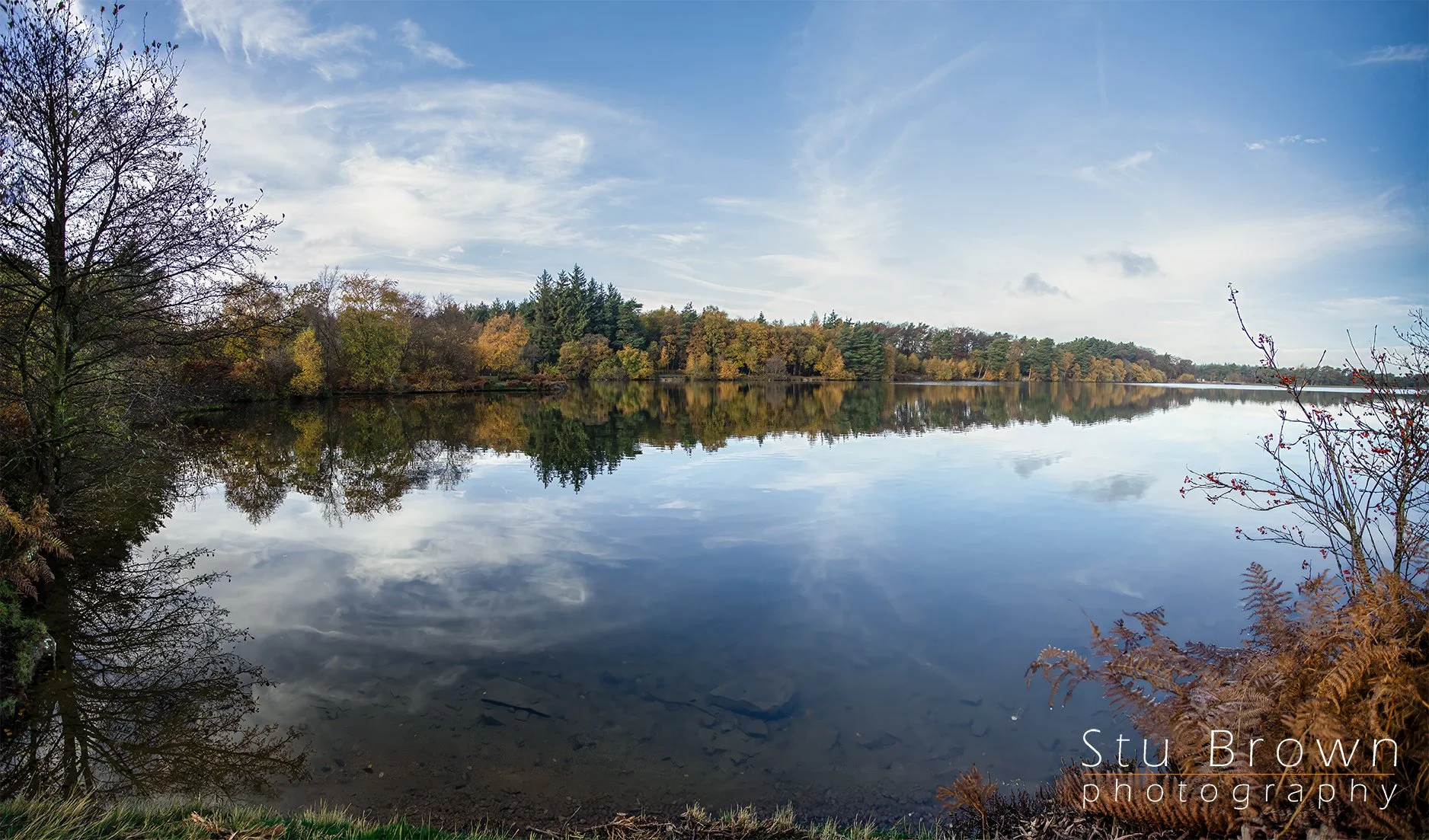
One of the first things people hear when they’re learning landscape photography is to keep the horizon out of the middle. It’s useful advice when you’re deciding whether the sky or the foreground deserves more room. With this photograph, though, the reflection was as much a part of the picture as what was above the water. Keeping the far bank close to the middle gave both halves enough space, and the trees and ferns at the edges helped frame the photograph.
This is the sort of thing I enjoy talking through on a workshop. If you’re unsure where to place the horizon, take a few photographs from the same spot. Give the sky more room in one, the water more room in another, then try it somewhere near the middle. When you look at them side by side, ask yourself which one makes you look at the part of the scene that caught your eye in the first place. That’s often a better way to settle it than trying to remember where the horizon is supposed to go.
Why I keep going back to places close to home
Lockwood Beck is close to home for me, and there’s something I like about being able to go out with the camera without making a whole day of it. It’s easy to spend so much time thinking about where to go next that you overlook the places you already know. The fly agaric and the reservoir photograph are a good reminder of that for me. I could have walked past the first one while looking for the second.
If you’ve got somewhere local you visit often, try giving yourself a bit longer in one spot next time. Take the photograph you spotted straight away, then see if there’s another one within a few steps of where you’re standing. It might be a closer detail, or it might just be a better version of the photograph you were already making.
If you’d like a hand with this sort of thing, I run landscape photography workshops and one-to-one tuition in North Yorkshire and the North East. Bring the camera you already use and we can work through those decisions together while you’re taking the photographs.
